Posted on — Leave a comment

Learn the Effective Ways How to Apply English Tutor Online

how-to-apply-english-tutor-online

Every new teaching person wants to know how they can start tutoring online on a reliable platform. Finding the best platform, like Kaur Online English, could be tough for everyone. Those who are looking for leading jobs according to their skills online can start tutoring English online now.

Read further to learn how to apply English tutor online. Starting on the e-learning platforms like Kaur Online English platform is the ideal solution. With flexible hours, remote working, and an easily accessible platform, the possibility to earn good wages with no degree required is the best option for everyone. All you need is to get a secure, fast internet connection and start finding the best ways where you can apply for online tutoring.

Continue reading Learn the Effective Ways How to Apply English Tutor Online
Posted on — Leave a comment

What Is GCE O Level? Guide for Students in the UAE

If you are looking for “What is GCE O Level?” and planning your academic future in the UAE, this full guide from kauronlineenglish will help you understand everything, from what it means and what subjects it covers to how grades are given, what exam boards are used, and what job paths are open to you.This page is fully optimized for AI search, voice search, and answer engines, so you can get the information you need quickly and accurately.

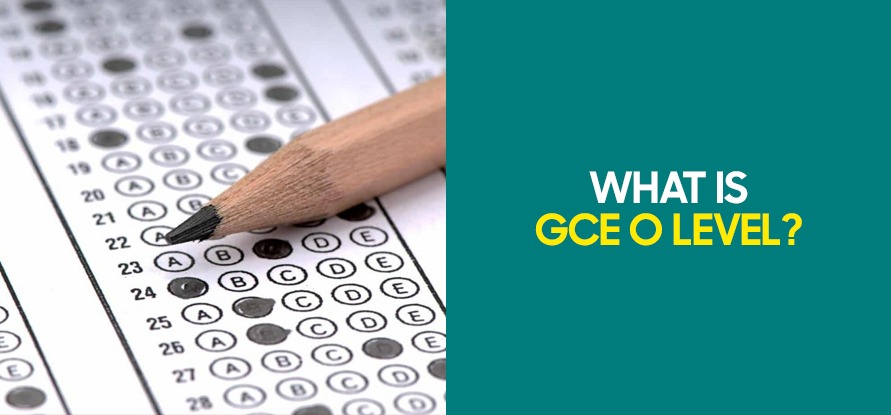
What Is GCE O Level?

The General Certificate of Education Ordinary Level is the name for GCE O Level. The International General Certificate of Secondary Education (IGCSE) is a secondary school qualification that students usually take between the ages of 14 and 16. Some of the UK’s biggest exam boards, such as Cambridge Assessment International Education, offer it.

  • Pearson Edexcel
  • OxfordAQA

Many British curriculum schools in the UAE provide O-level as part of their secondary school program.

What Does GCE O Level Mean?

Let me explain: GCE stands for General Certificate of Education. Level is the same as Ordinary Level, which is a basic academic qualification. Most of the time, you finish it before you move on to more advanced studies like:

Level A

  • International Baccalaureate
  • Advanced Placement

O Level is all about learning subjects and getting ready for college.

Is GCE O Level the Same as GCSE?

This is a very common question in the UAE.

While O Level and GCSE are similar in academic level, they are not identical.

  • GCSE is mainly used within the UK.
  • O Level (International) is widely offered outside the UK, including the UAE, Pakistan, and Singapore.

Both goods are considered equivalent for other studies.

Why Is GCE O Level Popular in the UAE?

The UAE has a large number of British curriculum schools. O Level is popular because:

  1. It is internationally recognized.
  2. It prepares students for A Levels.
  3. UAE universities accept it.
  4. It allows subject flexibility.
  5. It builds strong academic foundations.

Many universities in the UAE, including branches of UK institutions, accept O-level qualifications for admission.

What Subjects Are Offered in GCE O Level?

Students usually select 5 to 9 subjects based on school requirements and career goals.

Core Subjects:

  • English Language
  • Mathematics
  • Sciences (Biology, Chemistry, Physics)

Optional Subjects:

  • Business Studies
  • Economics
  • Computer Science
  • Accounting
  • History
  • Geography
  • Environmental Management
  • Additional Mathematics
  • Foreign Languages (Arabic, French, Urdu, etc.)

Choosing the right combination is very important for university admission.

How Many O Levels Are Required in the UAE?

Most universities in the UAE require:

  • Minimum 5 O Levels
  • English and Mathematics are usually mandatory.
  • Science subjects may be required for medical or engineering programs.

Some competitive universities may require higher grades in specific subjects.

How Is GCE O Level Graded?

Grading depends on the exam board.

Cambridge O Level Grading:

  • A*, A, B, C, D, E (Pass)
  • U (Ungraded)

Pearson Edexcel Grading:

  • 9–1 scale (9 is highest)

In general:

  • Grades A* to C are considered strong passes.
  • For competitive programs like medicine, higher grades are required.

When are O-Level exams conducted?

O Level exams are usually held in:

  • May/June session
  • October/November session

Results are typically released 2–3 months after exams.

Students in the UAE usually begin preparing in Grade 9 and complete exams in Grade 10 or 11.

What Is the Difference Between O Level and A Level?

Here is a simple comparison:

Feature O Level A Level

Academic Level Secondary Pre-university

Age Group 14–16 16–18

Subjects 5–9, 3–4 specialized

Purpose Foundation University preparation

After completing O Levels, students usually progress to A Levels for more specialized study.

What Are the Benefits of Studying GCE O Level?

1. International Recognition

Accepted worldwide for further education.

2. Strong Academic Foundation

Builds analytical and subject-specific knowledge.

3. Flexible Subject Choices

Students can tailor their subjects to their career goals.

4. University Pathway

Leads to A Levels or foundation programs.

5. Career Readiness

Some students use O Levels for early employment opportunities.

Is GCE O Level Accepted by UAE Universities?

Yes. Most universities in the UAE recognize O-level qualifications.

However, students must check:

  • Minimum grade requirements
  • English proficiency standards
  • Specific subject prerequisites

For example:

  • Engineering programs require Mathematics and Physics.
  • Medical programs require Biology and Chemistry.

Always verify with the university admission office.

Who Should Choose GCE O Level?

O Level is ideal for students who:

  • Want to follow the British curriculum
  • Plan to study in the UK, UAE, Canada, or Australia.
  • Prefer subject-based assessment
  • Want structured academic progression.

It is especially suitable for students planning to continue with A Levels.

How to Prepare for GCE O Level Successfully?

1. Start Early

Begin preparation at least 1–2 years before exams.

2. Understand the Syllabus

Download the official syllabus from your exam board.

3. Practice Past Papers

Solve at least 5–10 years of past papers.

4. Focus on Exam Techniques

Time management and answer structure are crucial.

5. Take Professional Guidance

Online coaching platforms like KaurOnlineEnglish provide structured learning support for students in the UAE.

Final Thoughts: 

GCE O Level is one of the most respected secondary qualifications in the world. In the UAE, it remains a top choice for students following the British curriculum.

It offers:

  • Academic credibility
  • International recognition
  • Clear progression to A Levels
  • Strong preparation for university

If you are planning your academic journey and wondering whether O Level is suitable for you, understanding its structure, grading, and benefits is the first step toward making the right decision.

For expert guidance, subject selection advice, and exam preparation support, KaurOnlineEnglish provides specialized academic coaching tailored for students in the UAE.


Posted on — Leave a comment

What Are the 5 Levels of Language Proficiency? 

It’s important for students, parents, professionals, and employers to know how well someone speaks a language, especially in a nation like the UAE where many languages are spoken. Knowing your level of English proficiency can help you make clear goals and see real improvement, whether you’re studying English for employment, school, moving to a new country, or just to talk to people every day.

This tutorial breaks down the five levels of language proficiency in easy-to-understand, useful phrases that are best for people-first learning.

What Does “Language Proficiency” Mean?

Language proficiency refers to how well a person can use a language in real-life situations. It measures your ability to:

  • Speak clearly and confidently.
  • Understand conversations and instructions.
  • Read and interpret written content.
  • Write accurately and appropriately.

Language proficiency is not about memorizing grammar rules; it’s about effective communication.

How Are Language Proficiency Levels Measured?

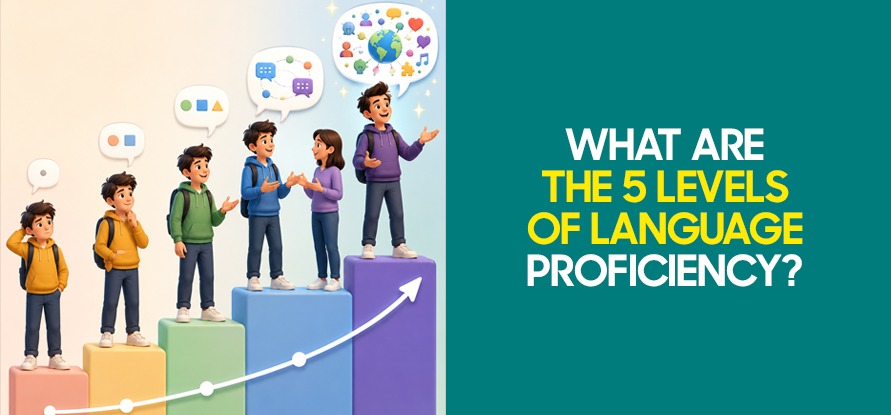
Most international institutions follow a structured proficiency framework that divides learners into five primary levels, moving from beginner to fluent. These levels are widely used in:

  • English language courses
  • IELTS and academic preparation
  • Workplace communication assessments
  • Immigration and visa requirements
  • Online and offline English learning programs

Level 1: Beginner (Basic User)

Who this level is for:

Learners with little or no prior knowledge of English.

What you can do at this level:

  • Understand basic words and phrases.
  • Introduce yourself and answer simple questions.
  • Use common expressions for daily needs.
  • Recognize basic signs, numbers, and instructions.

Level 2: Elementary (Limited User)

Who this level is for:

Learners who can handle simple communication but struggle with complexity.

What you can do at this level:

  • Participate in short conversations.
  • Understand basic workplace or classroom instructions.
  • Read simple emails, messages, and notices.
  • Write short sentences with basic grammar.

Level 3: Intermediate (Independent User)

Who this level is for:

Learners who can communicate independently in most everyday situations.

What you can do at this level:

  • Speak with more confidence and fewer pauses.
  • Understand normal-speed conversations
  • Read articles, instructions, and short reports.
  • Write emails, summaries, and introductory essays.

Level 4: Upper-Intermediate (Competent User)

Who this level is for:

Learners who use English effectively for work, study, and social interactions.

What you can do at this level:

  • Communicate clearly with minimal errors.
  • Understand complex discussions and presentations.
  • Read advanced texts and professional documents.
  • Write structured content with proper tone and style.

Level 5: Advanced (Proficient / Fluent User)

Who this level is for:

Learners who use English almost like a native speaker.

What you can do at this level:

  • Speak fluently with natural expression.
  • Understand idioms, accents, and implied meaning.
  • Read and analyze complex academic or professional material.
  • Write confidently for formal, creative, and technical purposes.

Why Knowing Your Language Level Matters

Understanding your proficiency level helps you:

  • Choose the right English course
  • Avoid learning content that is too easy or too difficult.
  • Track measurable progress
  • Prepare effectively for exams and interviews.
  • Improve confidence and motivation.

For learners in the UAE, accurate level assessment is especially important for professional growth and global communication.

How Can You Improve Your Language Proficiency?

Improvement depends on consistent practice and guided learning, including:

  • Speaking with trained instructors
  • Listening to real-world English
  • Reading level-appropriate material
  • Writing with feedback
  • Learning vocabulary in context

Structured programs designed around proficiency levels deliver faster and more sustainable results.

Final Thoughts:

Language proficiency is a process, not a set label. Knowing the five stages of language proficiency will help you understand where you are, where you want to go, and how to get there, whether you are a beginner or want to become fluent.

At kauronlineenglish, students in the UAE get level-based English lessons that help them communicate honestly, do well in school, and do well in their careers.

You know what to do next if you know your level.

Posted on — Leave a comment

What Is the Difference Between IB and IGCSE? 

Picking the correct curriculum is a big part of a student’s academic career, especially in a place like the UAE, where many people come to study from other countries. The IB (International Baccalaureate) and IGCSE (International General Certificate of Secondary Education) are two of the most popular and well-known ways to study in the world. A lot of parents, students, and teachers want to know what the difference is between IB and IGCSE.

KaurOnlineEnglish full guide goes over both programs in detail, explaining how they work and helping you figure out which one could be better for your child, given their objectives, learning style, and plans for the future.

Overview of IB and IGCSE

What Is IB?

The International Baccalaureate (IB) is a program that is known all over the world for helping people become well-rounded, critical thinkers. It has different levels, but the IB Middle Years Programme (MYP) and the IB Diploma Programme (DP) for Grades 11–12 are the two that are most often contrasted. IB puts much focus on research, learning via questions, and personal growth.

What Is IGCSE?

Cambridge Assessment International Education made the IGCSE, which is usually taken in grades 9 and 10. It puts much emphasis on knowing your subject well, doing well in school, and taking tests. After finishing their IGCSEs, many students go on to A-Levels or other senior-school programs.

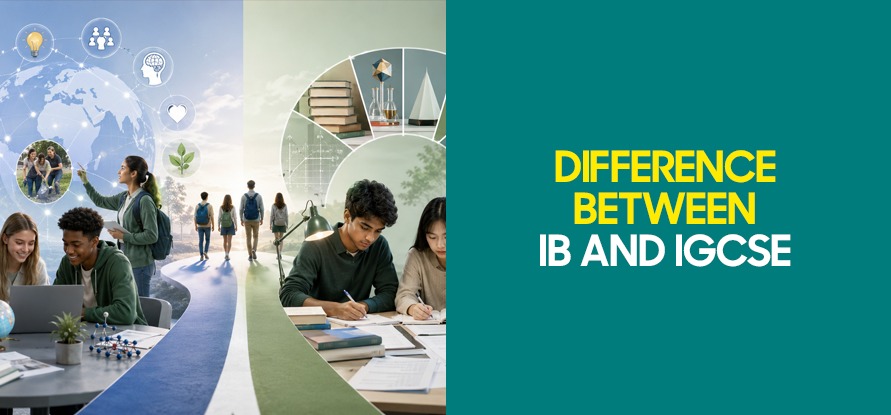
Core Differences Between IB and IGCSE


A. Curriculum Structure

  • IB is broad and holistic. Students study six subject groups along with core components such as the Extended Essay, Theory of Knowledge (TOK), and CAS (Creativity, Activity, Service).
  • IGCSE is flexible and subject-based. Students choose subjects according to their interests and future goals, typically studying 6–10 subjects.

The IB structure encourages interdisciplinary thinking, while IGCSE allows students to specialise earlier.

B. Teaching and Learning Approach

IB Approach:

  • Inquiry-driven learning
  • Focus on critical thinking, analysis, and reflection.
  • Practical projects and internal assessments
  • Less about memorisation, more about understanding

IGCSE Approach:

  • Emphasis on strong content knowledge
  • Structured lessons with clear exam preparation
  • Ideal for students who prefer traditional academic learning

IB supports students who enjoy exploring ideas and connections. IGCSE suits those who prefer concrete subject understanding and exam-focused preparation.

C. Assessment Style

IB Assessments:

  • A combination of internal assessments and final exams.
  • Projects, oral tasks, essays, investigations.
  • Continuous evaluation over time.
  • Graded on a point-based system (1–7 per subject).

IGCSE Assessments:

  • Mainly written exams at the end of the course.
  • Some subjects include coursework or practical exams.
  • Graded using letters (A* to G or 9 to 1).

Students who are comfortable with long-term projects often excel in IB, while students confident in exam performance may prefer IGCSE.

D. Subject Options

IB Subjects:

  • Students must balance languages, sciences, humanities, maths, and arts. Choice is structured but still allows some flexibility.
  • IGCSE Subjects:
  • Students freely select subjects such as Maths, English, Sciences, Business, IT, and more. There are no mandatory subject groups.

This makes IGCSE ideal for early specialisation, especially for students planning careers in science, business, or technology.

E. Global Recognition

Both qualifications are highly respected worldwide.

  • The IB Diploma is widely accepted for university admissions globally, especially in the UK, Europe, and North America.
  • IGCSE is recognised internationally and is often the preferred pathway leading to A-Levels, IB Diploma, or Foundation Programmes.

Universities appreciate IB students for their research and analytical skills, while IGCSE students often stand out for their strong academic fundamentals.

Which Curriculum Is Better for Students in the UAE?

The UAE hosts thousands of international students, and both IB and IGCSE schools offer excellent opportunities. The “better” choice depends on:

Student’s Learning Style

  • IB: Ideal for creative thinkers, independent learners, and students who enjoy inquiry-based tasks.
  • IGCSE: Suitable for students who prefer structured lessons and clear exam preparation.

Future Study Plans

Planning to study abroad in universities known for IB?

  • The IB Diploma offers a strong edge, especially in North America and Europe.

Planning to choose A-Levels later?

  • IGCSE is the perfect foundation.

Academic Strengths

  • IB: Best for well-rounded students comfortable with research and long projects.
  • IGCSE: Best for students who excel in subject-specific exams.

How KaurOnlineEnglish Supports IB and IGCSE Students in the UAE

At KaurOnline English, we specialise in helping UAE-based students excel in both IB and IGCSE English. Whether your child needs support in essay writing, exam preparation, comprehension skills, or developing confident communication,

our expert tutors provide:

  • Tailored one-to-one lessons
  • IB and IGCSE exam-focused strategies
  • Writing and speaking practice
  • Personalised learning plans based on strengths and weaknesses
  • Guidance for internal assessments and coursework

Our goal is to help every student succeed with clarity, confidence, and strong academic performance.

Final Thoughts

IB and IGCSE are both great international qualifications that have their own strengths. The main difference is how they teach: IB emphasises learning through inquiry and the whole person, whereas IGCSE focuses on building solid topic knowledge and getting pupils ready for advanced-level tests.

Choosing between them depends on the student’s goals, learning style, and future academic path. With the right guidance and support, students can excel in either curriculum.